
“I want to show a picture of someone with brightly colored hair and using a wheelchair—isn’t there a program that can do that?”
The answer is yes and no. While AI image generators have come a long way in a short time, it’s still rare to find one that can deliver the exact image you want on the first prompt (for now, at least). Just like magic can’t happen without a magician, a good AI image can’t be made without a creative person.
How is an AI image conjured?
Using images and text samples from all over the internet, a program will pull from these images and create a new image based on text prompts provided by a human user.
The image is a collage of multiple sources to create one image, but who owns it? This is a highly debatable subject right now and there is no clear answer. However, there are a few things to consider when using AI imagery:
- AI-generated images are not considered the work of a human creator and cannot be copyrighted.
- How ethical is it. For example, you should not create AI images of real people without consent.
So, let’s wave our magic wands and see what we come up with:
The Prompt
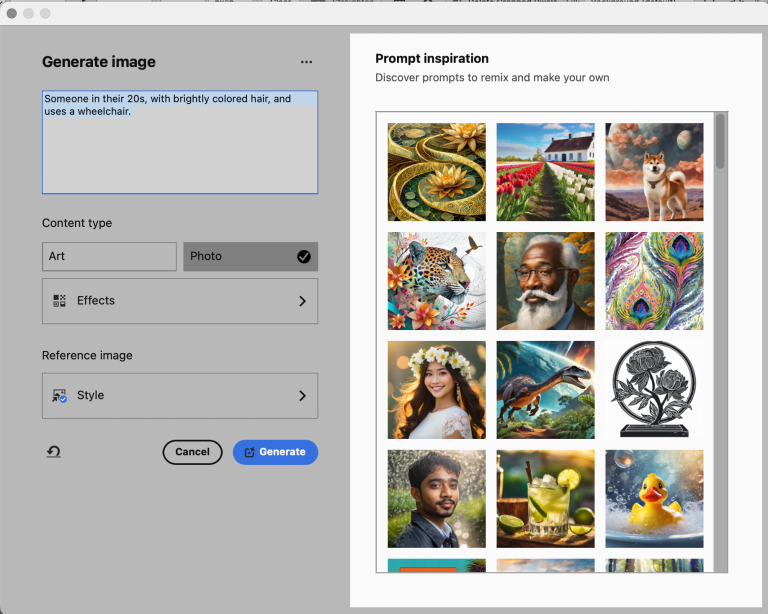
Let’s go back to our original prompt: someone in their 20s with brightly colored hair and uses a wheelchair. We used Adobe’s AI image generator for this example.
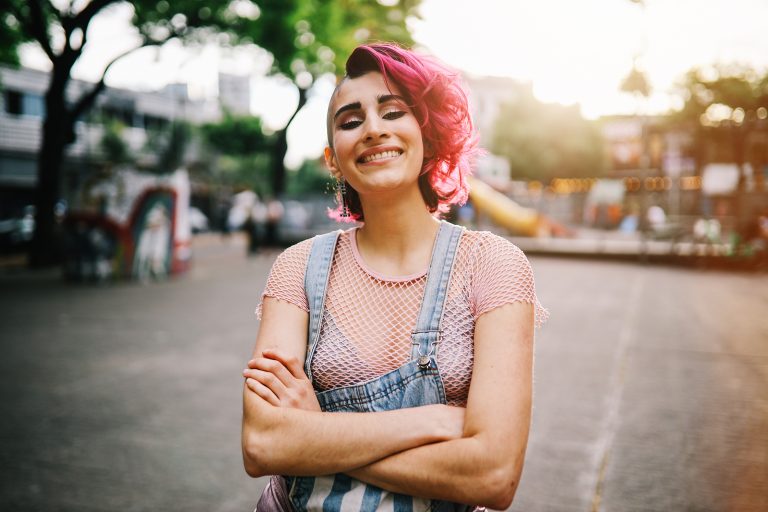
The Reference
This was the selected reference image we wanted the generated image to emulate.
The Initial Results
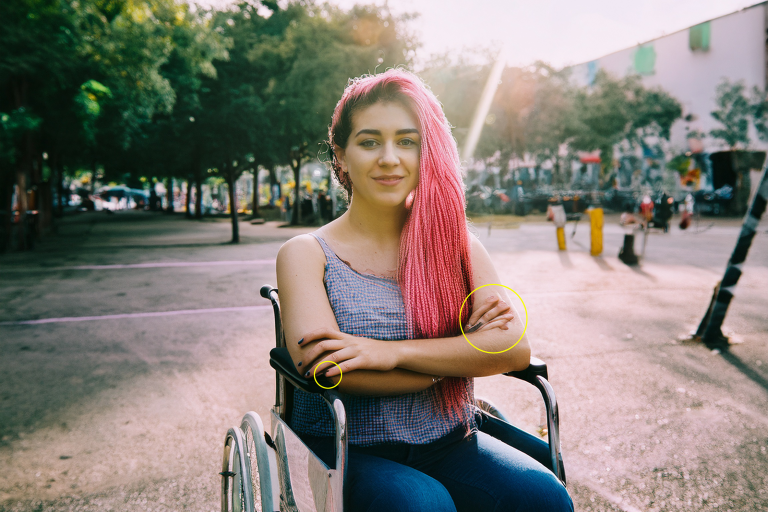
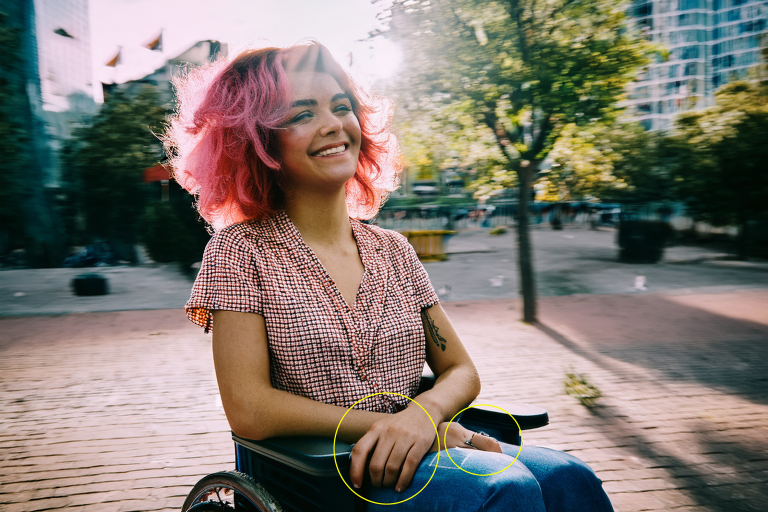
These were the three generated images based on our prompt and reference photo. As you can see from the initial results, the AI struggled to properly render subjects’ hands and fingers. But you don’t have to pick the best of the not-so-great bunch and use it.

Refining the Results
To improve the image, we selected the problem areas (the hands) and provided the AI image generator with several new prompts in an effort to cover the hands. After testing a purse, laptop, backpack, and tablet, a sweatshirt was the best-looking addition to the photo.
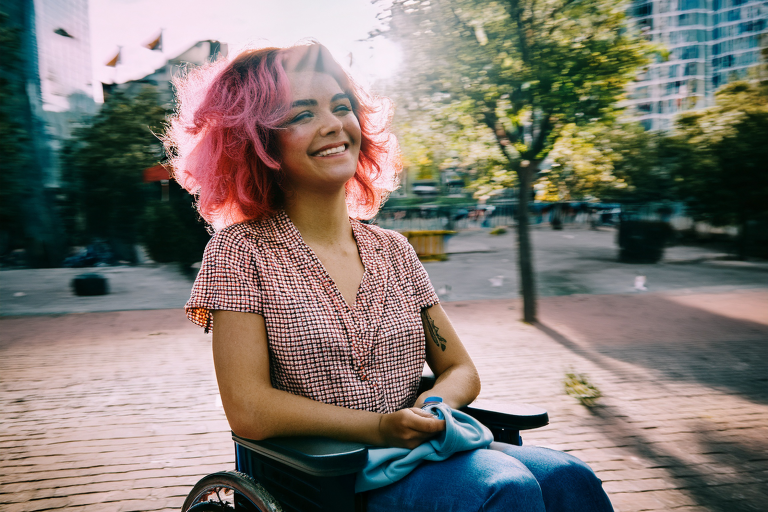
Inevitably, AI image generation takes some trial and error; in this example, it took us several prompts to arrive at an image that was workable. This is part of why AI still needs a human to prompt and direct different outcomes to arrive at the desired final product.
Mishaps to look out for:
While AI image generators have come a long way, they still exhibit some consistent issues that users should be aware of. Here are a few common pitfalls to watch for:
- Human Faces and Expressions: AI-generated images often struggle with accurately depicting human faces and expressions. This difficulty arises from the subtleties of human features and the variations in emotional expression that can be nuanced and context dependent. As a result, you might notice inconsistent facial features, unnatural proportions, or mismatched expressions that don’t align with the context of the image.
- Complex Anatomy: Due to the human body’s intricate structure and all positions it can take, AI often produces images where certain features appear distorted, misshaped, or incorrectly rendered. This is most common with hands, teeth, and ears.
- Overlapping Elements and Nonsensical Outputs: As AI becomes more complex, the likelihood of generating overlapping elements increases. This could manifest as text that is nonsensical or objects within the image interacting in unrealistic ways, like items that seem to float or defy gravity. Such anomalies are a result of the model attempting to combine various elements without a coherent understanding of spatial relationships, leading to jarring or illogical images.
Common creative concerns:
- Lack of originality: AI-generated images may lack the creativity and interpretation that human artists bring to their work.
- Formulaic: AI-generated images may use a formulaic approach instead of the unpredictable and rich imagination of human artists.
- Technical flaws: AI-generated images may have technical flaws, such as incorrect anatomy, lack of perspective, and uniform texture.
- Misinformation: AI-generated images can be used to create deepfakes, which can be harmful.
Best practices to keep in mind:
- Obtain written permission before using real people or their likeness.
- Use original or ethically sourced imagery as a foundation for AI creations.
- Familiarize yourself with the AI software’s terms and conditions before use.
- Be transparent—disclose when an image has been created with AI.
- Avoid misleading others.